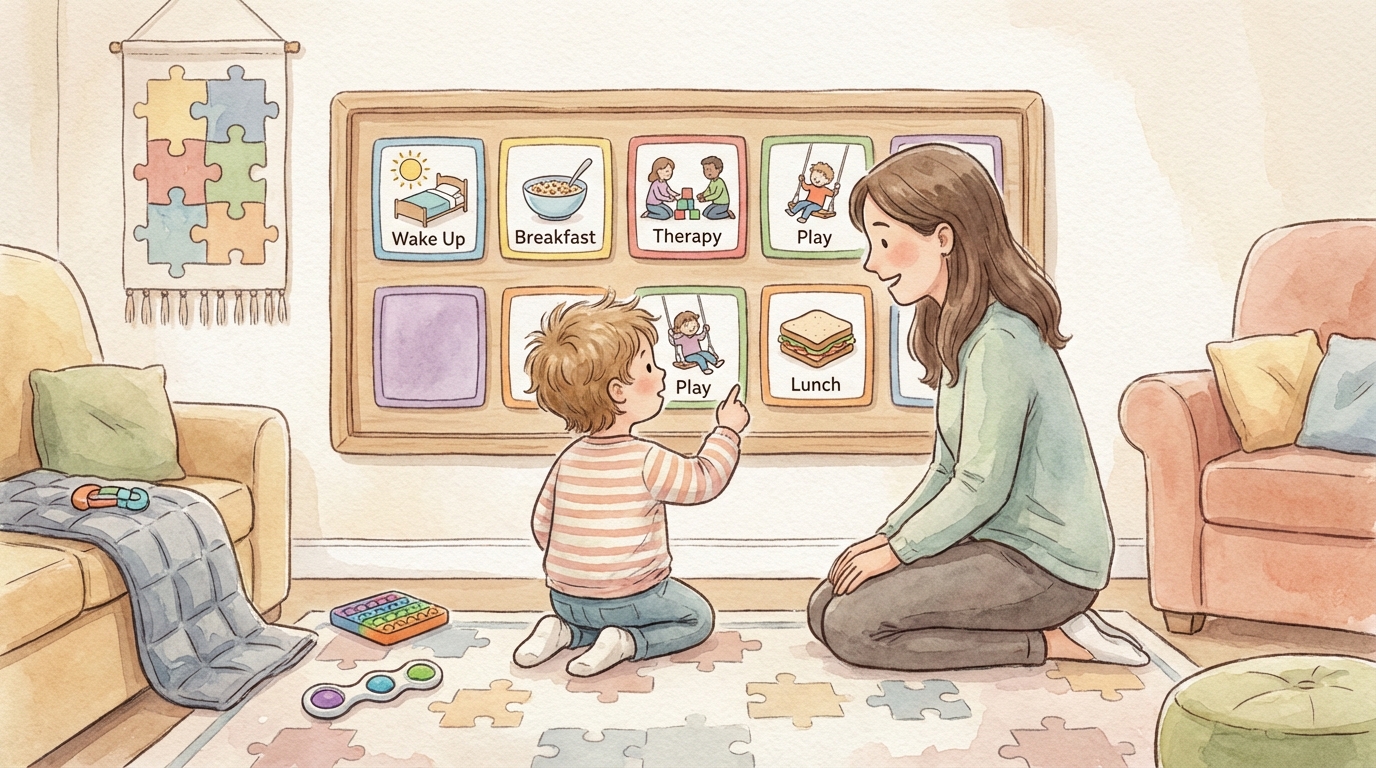

If you're a parent or therapist of a child with autism, you've probably heard: 'Use a visual schedule.' But what does that actually mean? And how do you create one that truly works?
This guide covers everything — from the science behind visual schedules to practical implementation tips for both parents and therapists.
Why Visual Schedules Work for Children with Autism
Many children with autism process visual information more effectively than auditory information. When you say 'Time to brush teeth,' the instruction vanishes into the air. A visual schedule stays — concrete, predictable, revisable.
Research shows that visual schedules reduce anxiety by making the day predictable, decrease reliance on adult prompts, and increase independence. For many autistic children, the visual schedule isn't just helpful — it's essential.
Types of Visual Schedules
There's no one-size-fits-all visual schedule. The best kind depends on the child's age, skill level, and preferences:
- First-Then Boards: Simple and immediate ('First brush, then iPad')
- Full-Day Schedules: Entire day sequence on a strip or grid
- Activity-Specific Schedules: Steps for a single task (e.g., handwashing)
- Transition Schedules: Help move from one activity to another
- Mini Schedules: Portable, for outings or appointments
Start simple. A first-then board might be all you need initially. As the child gets comfortable, you can expand to multi-step schedules.
How ABA Uses Visual Schedules
ABA therapy (Applied Behavior Analysis) relies heavily on visual supports. Therapists use visual schedules to:
- Task chain: Break complex routines into small steps
- Provide prompts: Visual guidance instead of constant verbal direction
- Increase independence: Child checks schedule, doesn't wait for instructions
- Reduce challenging behaviors: Predictability = less anxiety = fewer meltdowns
- Teach flexibility: Schedules can be adjusted, teaching that change is okay
A skilled ABA therapist can help you create a visual schedule perfectly aligned with your child's goals.
A visual schedule isn't a crutch — it's an independence tool. The goal is for the child to use it themselves.
Practical Tips for Parents
Creating an effective visual schedule isn't about artistic perfection — it's about clarity and consistency:
- Use real photos or clear illustrations, not abstract symbols
- One activity per card/panel — don't overwhelm
- Place it at the child's eye level, not hidden in a drawer
- Make it interactive: let the child flip cards, check off completed steps
- Be consistent: use the schedule every day, not just when you 'need it'
- Celebrate successes: 'You checked your schedule all by yourself!'
For children who love predictability, take a photo of the assembled schedule. If something changes (unexpected doctor visit), show the photo of the 'usual' schedule and explain 'Today is different.' This validates their feelings.
Tips for Therapists and Educators
If you're an occupational therapist, speech therapist, or special education teacher, visual schedules are essential for generalization:
- Collaborate with families: Use the same images at home and in therapy
- Teach the family to use it: Don't just hand over a schedule, teach implementation
- Incorporate special interests: If the child loves dinosaurs, use dinosaur-themed frames
- Fade prompts gradually: Start pointing, then just looking, then full independence
- Document progress: Before/after data shows parents the impact
The Power of Personalization
Generic schedules work, but personalized schedules work BETTER. When a child with autism sees their own likeness in the schedule, engagement increases dramatically.
Research on video modeling (where autistic children learn by watching themselves on video) shows that seeing oneself improves skill acquisition compared to seeing other people. The same principle applies to visual schedules.
littleHero creates a consistent cartoon character of your child that appears across all routine scenes. For autistic children who thrive on consistency, seeing the SAME 'me' in every step can be incredibly powerful.
Troubleshooting Common Issues
Problem: 'My child ignores the schedule.' Solution: Make it interactive — let them flip cards, stick velcro, check boxes. Physical engagement increases use.
Problem: 'She gets upset if the order changes.' Solution: That's good! Predictability is the goal. But teach flexibility gradually: 'Today school COMES BEFORE park. See, I moved the cards.'
Problem: 'He memorized everything and doesn't look anymore.' Solution: Celebrate! That IS independence. Now use the schedule for new routines or unfamiliar situations.
Language and Perspective
A note on language: Many autistic people prefer identity-first language ('autistic person') while others prefer person-first language ('person with autism'). There's no universal consensus, and both are valid. In this article, we use both to respect all preferences.
Most importantly: see the visual schedule not as a 'fix' but as an accommodation — a tool that levels the playing field and allows the child to thrive on their own terms.
Additional Resources
Visual schedules are one of the most evidence-based tools for supporting children with autism. With personalization, consistency, and patience, they can transform chaotic routines into predictable, empowering rituals.