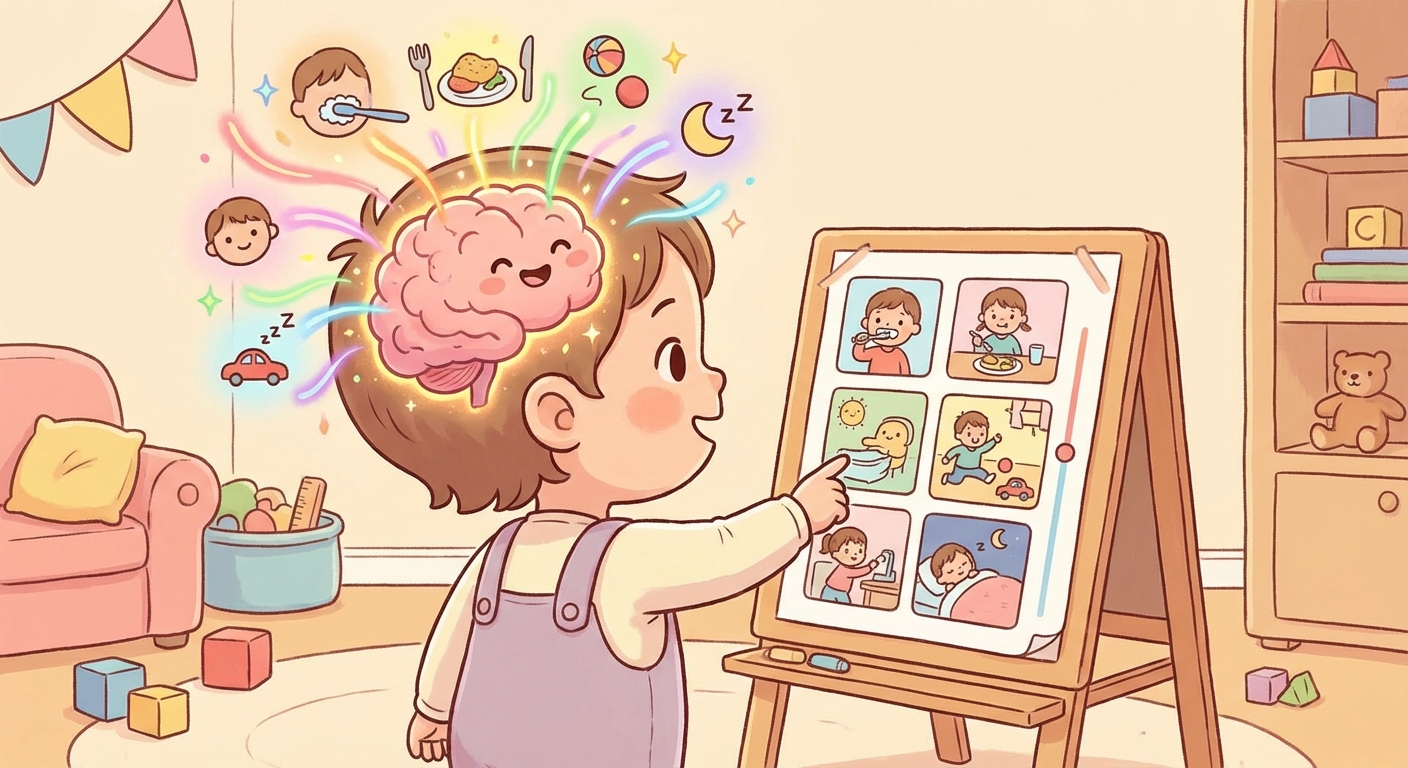

Have you ever wondered why your child understands a cartoon but struggles to follow verbal instructions? The answer lies in how children's brains process information.
The Child's Visual Brain
Children between 1 and 6 years old are in a developmental stage where the visual cortex is much more developed than complex linguistic processing areas. Neuroscience studies show that up to 65% of childhood learning happens through visual stimuli.
A picture is worth a thousand words — especially for a 3-year-old who is still developing verbal comprehension.
Why Visual Routines Work
- Reduce cognitive load: the child doesn't need to remember all the steps
- Create predictability: knowing what comes next reduces anxiety
- Promote autonomy: the child can 'read' what to do on their own
- Eliminate conflicts: the chart is the authority, not you
The Power of Identification
When children see themselves represented on the routine chart — with their own character doing the activities — engagement increases dramatically. This activates mirror neurons, the same brain region responsible for imitation and social learning.
💡 Tip
Place the routine chart at the child's eye level for maximum visual engagement.