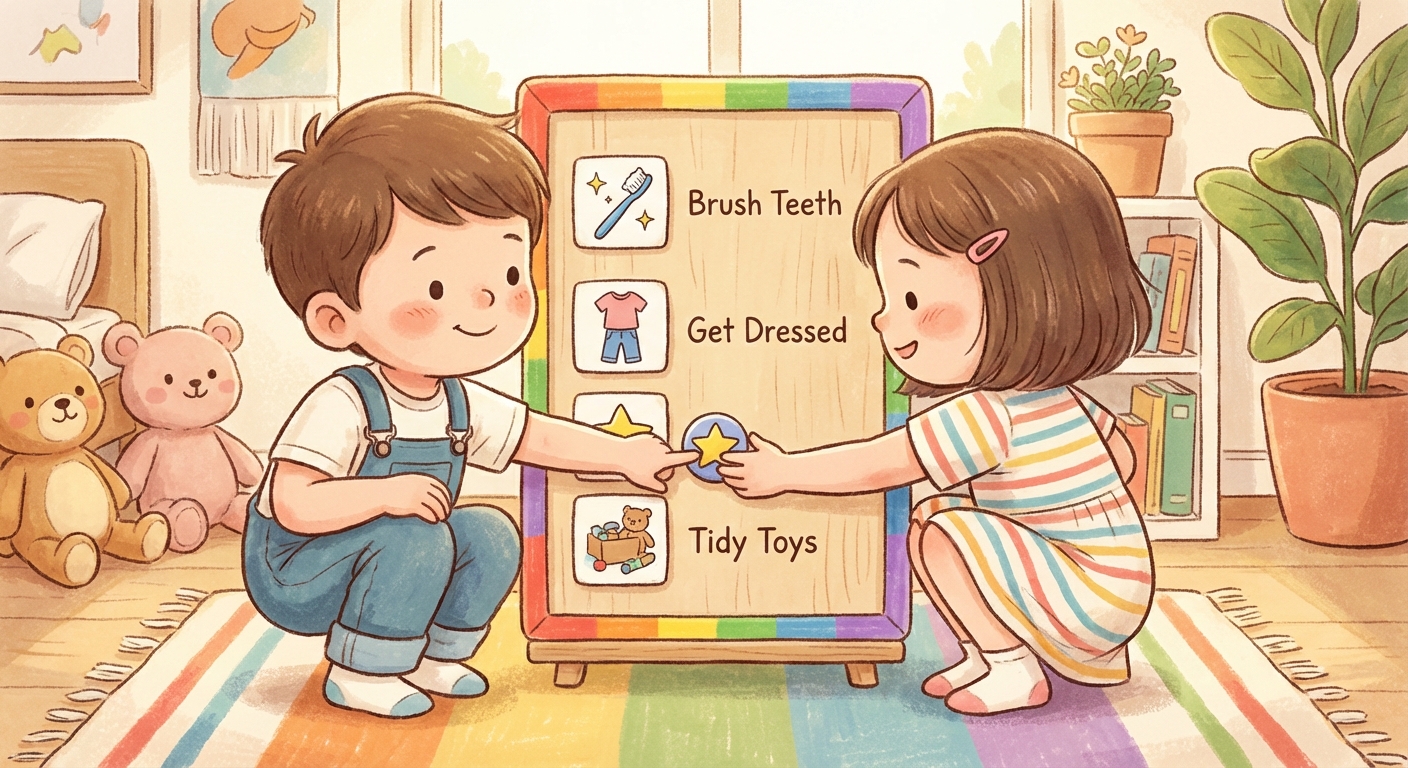

When you have more than one child, the math changes completely. It's not 1+1=2, it's more like 1+1=exponential chaos. But with the right strategies, routines with siblings can become moments of cooperation instead of conflict.
Research shows that sibling rivalry is normal and even healthy — it teaches negotiation, conflict resolution, and sharing. The problem arises when conflicts dominate daily life.
Why Siblings Fight During Routines
Competition for resources: who uses the bathroom first? Who sits where? Who picks the book?
Pace differences: one is fast, the other is slow. One wakes up early, the other sleeps in.
Attention seeking: routines are moments of adult attention, and siblings compete for it.
Perceived fairness: 'Why can she and I can't?' is every sibling's mantra worldwide.
Individual vs. Shared Routine Charts
Each approach has advantages. Individual charts respect different paces and give a sense of identity. Shared charts promote teamwork and reduce comparisons. Many families use a combination.
For siblings with very different ages, use individual charts with distinct colors or characters. For close ages, consider a joint chart with parallel or team tasks.
Strategies That Work
Turn-taking system: who goes first in the bathroom alternates each day. Use a visual calendar so there's no argument ('today is blue day, tomorrow is green day').
Team tasks: some activities work better together. 'You both clean up the toys together' can create cooperation.
Individual time: each child needs moments alone with you. Even 10 minutes of 'special time' per day reduces competition for attention.
- Avoid comparisons ('Look how your sister is already ready!')
- Celebrate cooperation ('What a team you make!')
- Let them resolve small conflicts on their own when possible
- Have clear rules for disputed resources
- Recognize each one's individuality
Twins and Multiples
With twins, synchronization is tempting but not always ideal. Some twins benefit from identical routines, others need differentiation. Observe what works for yours.
Tip for twins: use different colors or symbols to identify each one's items (green and blue toothbrush, towel with star and towel with moon). This reduces possession conflicts.
Can the Oldest Help?
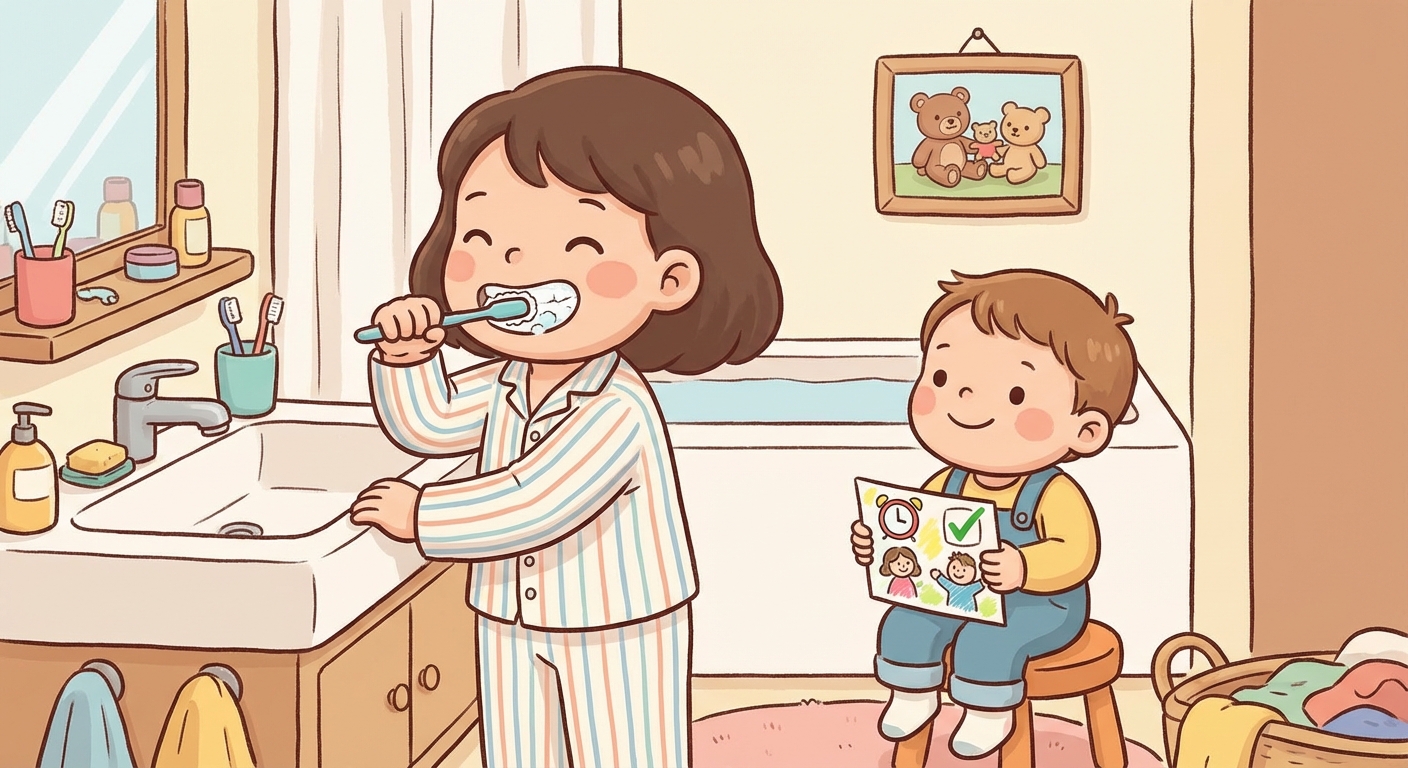
With care. The older sibling can be a model ('show João how we brush teeth'), but shouldn't be made responsible for the younger one. 'Take care of your sibling' is too heavy a burden for a child.
Involve the oldest as a 'helper', not as 'responsible'. And always acknowledge the effort: 'How nice that you showed Maria, she learns so much from you'.
When Fights Happen
And they will. When possible, don't take sides. 'You both seem upset. Let's find a solution together.' If you need to separate, separate both, not just 'the guilty one'.
After things calm down, help them repair the relationship: 'What can you do to make your sibling feel better?' Teaching repair is more valuable than finding the culprit.