You've bought a generic routine chart before — the kind with cute clipart of anonymous children brushing teeth — and watched your kid completely ignore it. It's not you. It's neuroscience.
Research shows that when a child sees their own likeness in a routine chart, compliance increases by up to 40%. It's not magic. It's how our brains process identity and action.
The Mirror Effect: Why 'Me' Matters
Our brains have mirror neurons — cells that fire both when we perform an action AND when we see someone else perform it. But here's the kicker: these neurons fire MORE intensely when we see someone who looks like us.
A 2019 study in the journal Developmental Science found that children ages 2-5 were twice as likely to imitate behaviors when they saw a character that resembled them versus a generic character.
Representation and Motivation
When a child sees 'themselves' completing routine tasks, it's not just recognition — it's mental rehearsal. Their brain is practicing the sequence before they even physically do it.
Think of it like mental rehearsal for athletes, but for 3-year-olds brushing their teeth. Personalization transforms a passive chart into an active rehearsal tool.
It's not narcissism — it's neuroscience. Seeing 'me' doing the task makes the task part of my identity.
The Problem with Generic Clipart
Traditional routine charts use stock illustrations because they're quick and cheap. But they completely miss the power of representation:
- Generic child → low identification → low engagement
- Different skin tone child → disconnection
- Lifeless art style → no emotional connection
- Same character repeated 8 panels → visual boredom
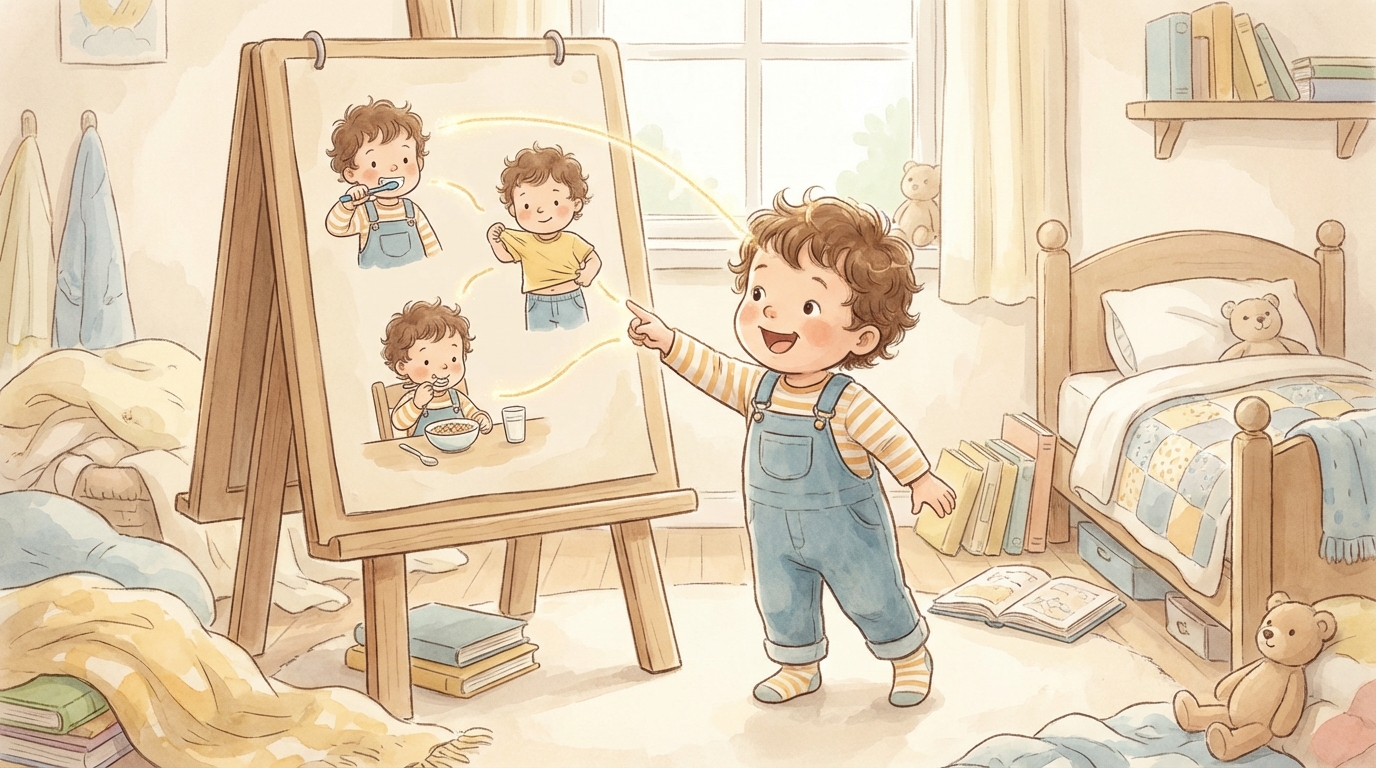
Compare that to a personalized chart where the child actually recognizes themselves: 'That's ME! I'm putting on my shoes!' Instant engagement.
What the Research Shows
A 2021 study with children with autism (who often benefit greatly from visual schedules) found that personalized visual schedules led to:
- 43% increase in independent task initiation
- 52% decrease in parent/caregiver prompts
- 38% improvement in task sequence completion
- Stronger skill retention over time
And while the study focused on autistic children, the principles apply to all kids — because all brains respond better to personal representation.
How littleHero Creates Personalization
Our approach uses AI to transform a photo of your child into a consistent cartoon character that appears across all routine scenes. It's not just about likeness — it's about identity:
- Skin tone, hair color, unique features preserved
- Consistent art style across all scenes
- The character 'grows' with the child
- Positive, empowering expressions
When your child sees themselves in the routine chart, ask: 'Who's that doing such a great job brushing teeth?' Let them say 'It's ME!' — that vocal recognition reinforces the connection.
Beyond Personalization: Context Matters Too
Personalization is powerful, but it works even better when combined with relevant context. A chart showing 'you' brushing teeth in 'your' bathroom (same tile, same sink) is even more effective.
That's why we encourage parents to add details: 'Does she use a pink step stool?' 'Does the school uniform have a blue stripe?' These small touches turn recognition into deep connection.
The Bottom Line
Generic charts can work for a while — any visual structure is better than none. But if you're wondering why your child isn't engaging, lack of personalization is probably the answer.
When a child sees themselves as the star of their own routine, they're not just following steps — they're rehearsing their identity. And that makes all the difference.